This One Setting Is Splitting Bitcoin
Want the real story behind the shouting, the incentives, and why this matters to fees, decentralization, and Lightning? Unlock the full post and I will walk you through what changed, who benefits, and what I think the right default should be.
Bitcoin is more than a digital asset. It is a network of computers, called nodes, that constantly share new transactions with each other. This serves two main purposes. First, it helps nodes gauge how many transactions are vying for a spot on Bitcoin's permanent ledger. Second, it ensures transactions reach miners - specialized computers that burn massive amounts of electricity guessing random numbers. When a miner guesses correctly, they earn the right to select a batch of transactions, known as a block, to add to Bitcoin's unchangeable ledger. Each block can hold about 3,000 transactions, and the winning miner collects the associated fees plus a small amount of newly created Bitcoin.
The current debate centers on "spam" transactions - those embedding extra data beyond simple payments. Since Bitcoin's early days, people have found ways to add extra data to transactions, from permanently etching their names on the blockchain to uploading images or timestamping data for proof of existence. Depending on one's view of Bitcoin's purpose, this extra data is often labeled "spam."
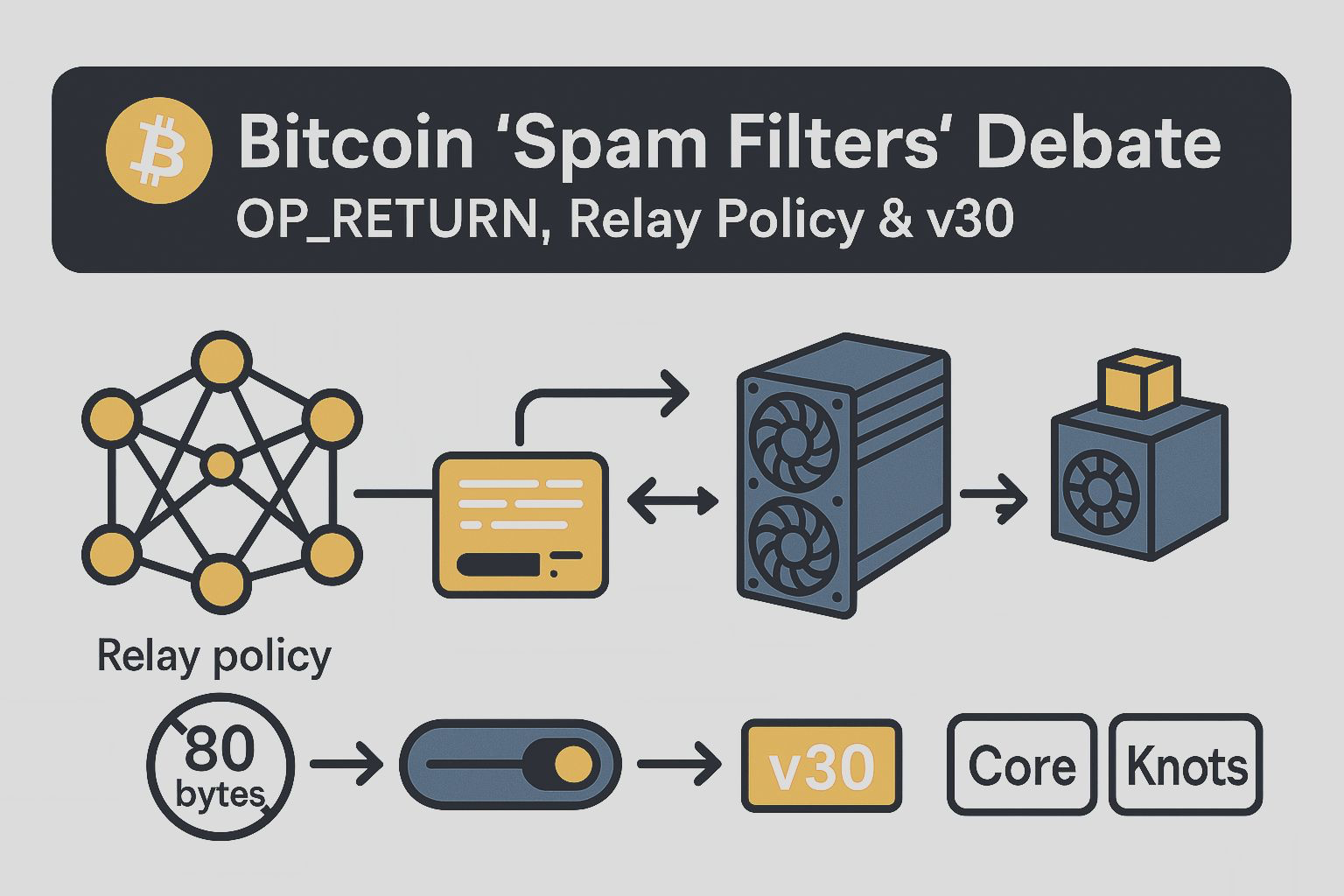
To curb this, developers introduced controls about a decade ago, including a limit on the size of a transaction's OP_RETURN field - a placeholder for extra data. Nodes were set to relay only transactions with OP_RETURN data under 80 bytes. If the data exceeded this, the transaction wouldn't be relayed to other nodes. However, this limit only applied to node-to-node relaying, not to what miners could include in a block. Miners follow "consensus rules," which dictate what’s valid for the blockchain. Since large OP_RETURN data doesn't violate these rules, some users began paying miners directly to include oversized transactions in blocks, bypassing the relay network entirely.
This brings us to recent events. Developers of Bitcoin Core, the most widely used Bitcoin software, proposed a change in the upcoming version 30 update, set to activate around October 10, 2025. This change removes the default 80-byte OP_RETURN limit for transaction relaying, sparking heated debate in the community.
Luke Dash Jr., a veteran Bitcoin Core developer who also pioneered Bitcoin’s compatibility with the Lightning Network, maintains a separate software called Bitcoin Knots. Knots aligns with Bitcoin Core's consensus rules but offers customizable relay policies, often called "spam filters." These allow node operators to set their own OP_RETURN size limits, among other controls. Since the Bitcoin Core announcement, about 20% of known Bitcoin nodes have switched from Core to Knots, reflecting community division over the change.
The debate involves technical, social, and economic arguments, with each side holding firm views on Bitcoin's purpose and how to manage its resources. If you'd like, I can share my personal take on the matter.
Hope this helped.